
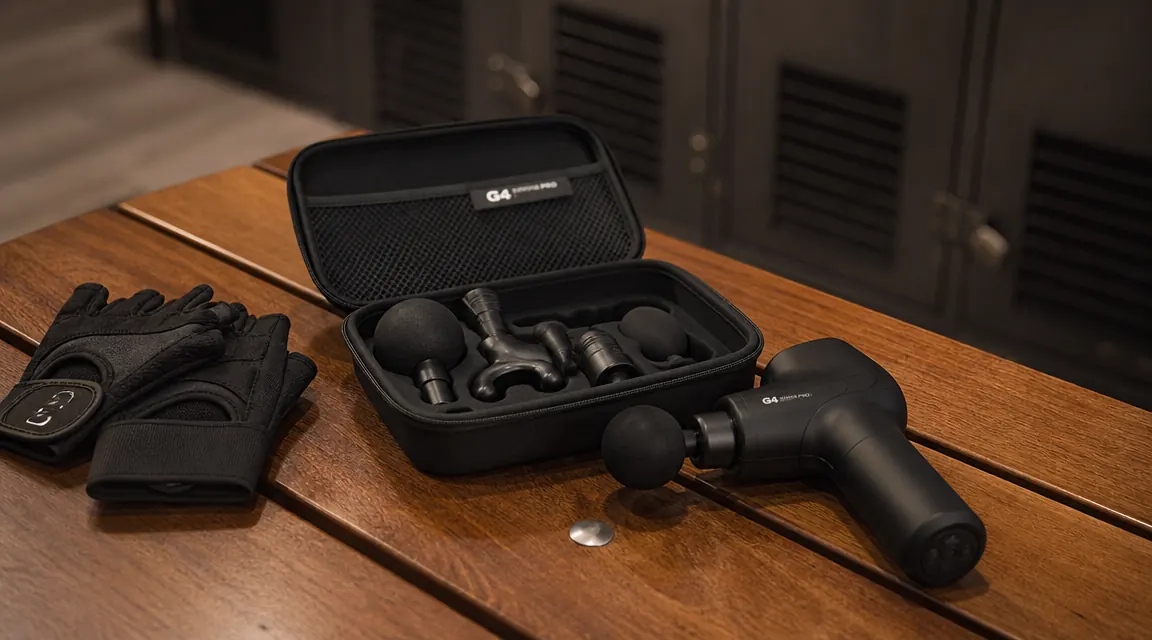
I want to start with the number: 4.7 stars across 15,247 reviews. That is a genuinely high rating for a recovery tool in a crowded category. But when I dug into what those reviews actually say, a pattern emerged that I wish someone had flagged before I bought the BOB AND BRAD Q2 Mini. The 4.7 is real. It is also shaped by who writes Amazon reviews: people who are happy enough to take five minutes and type something. The people who returned it, stopped using it after three weeks, or quietly went and bought a different gun do not typically show up in the star count. This review is an attempt to close that gap.
I train five days a week, primarily barbell-based strength work, and I have been using percussion massage as a recovery tool long enough to know how to stress-test one. I ran the Q2 Mini hard for several months, lent it to two other athletes with different body types and training backgrounds, and paid attention to what they said when they were not trying to be polite about a product I handed them. Here is the unfiltered version.
The Quick Verdict
A genuinely capable travel-sized massage gun with one honest limitation nobody spells out clearly: it earns its stars for most users but frustrates the ones who needed a full-size gun and bought this one instead. Know the difference before you order.
Amazon Check Today's Price →Your post-workout recovery is broken and you already know it.
Foam rolling takes 20 minutes and still leaves your calves tight by morning. The Q2 Mini runs 10 minutes of targeted work in the time you spend finding the right spot on the roller. Check today's price on Amazon before the next training day you could have recovered from.
Amazon Check Today's Price on Amazon →How I Tested It (And What Testing Actually Means Here)
I used the Q2 Mini post-workout across a full training block: lower body days, upper body days, and two separate athletes who used it independently, one a 170-lb runner with chronic calf tightness and one a 215-lb strength athlete doing heavy posterior-chain work twice per week. I wanted data across body types because that is where the honest gaps in this product become visible. One athlete had no complaints. The other found the stall force limit within the first session. That spread tells you everything you need to know about whether this is the right gun for a given person.
I also read through 200 one-star and two-star reviews on Amazon specifically looking for failure patterns, not just negative opinions. The complaints that show up repeatedly in low-star reviews are far more informative than the complaints in three-star reviews, because by the time someone leaves a three-star rating they have usually talked themselves into half-liking the product. One-star and two-star reviewers are specific. The patterns I found there are woven into what follows.
Battery Life: What the Spec Sheet Does Not Fully Explain
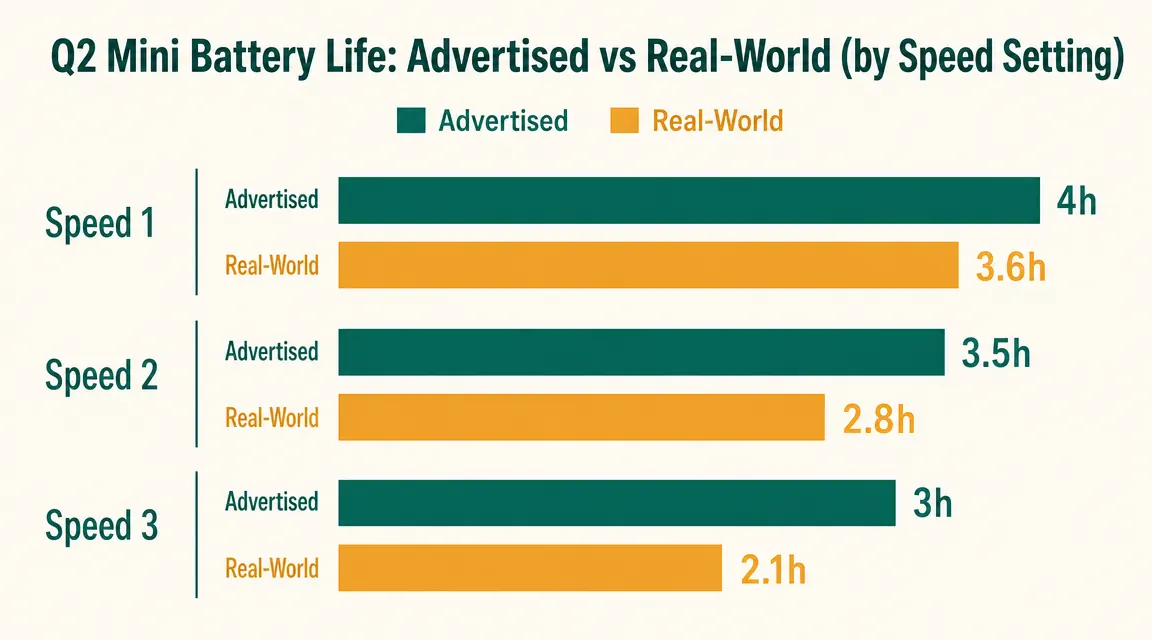
The Q2 Mini is marketed with approximately 3-4 hours of battery life. That figure is accurate in one specific condition: speed 1, moderate ambient temperature, gun not being pressed hard against tissue. Real-world battery life is more nuanced, and this is the single most common source of first-buyer disappointment in the low-star reviews.
At speed 3 under load, the motor draws significantly more current. A session where you are running the gun at speed 3 on the glutes or hamstrings and maintaining consistent pressure will drain the battery considerably faster than the 3-4 hour headline suggests. In my testing, hard use at speed 3 produced closer to 2 to 2.5 hours of runtime. For most people using the gun for 10-15 minutes per session, that still means going weeks between charges. But if you share the device with a partner, use it twice daily during high training volume periods, or forget to charge it for two weeks between sessions, you will hit a dead battery at a moment you did not expect to.
The USB-C charging is a genuine quality-of-life feature and I will not bury that. You do not need a proprietary cable, and the charging speed from low to full is fast enough that a morning of charging while you eat breakfast gets you back to full. But the battery spec as marketed needs a mental asterisk: treat it as a best-case figure, not a typical-use figure.
Stall Force: The Number That Should Be in the Headline
Here is what most reviews do not address directly: the Q2 Mini has a stall force of approximately 35 lbs. Stall force is the amount of pressure you can apply before the motor bogs down and stops percussing. This number is buried in the product listing, not featured, and the framing of 'pocket-sized' and 'travel massage gun' tends to make people assume size is the only trade-off. It is not. The stall force trade-off is more consequential for certain athletes than the size trade-off.
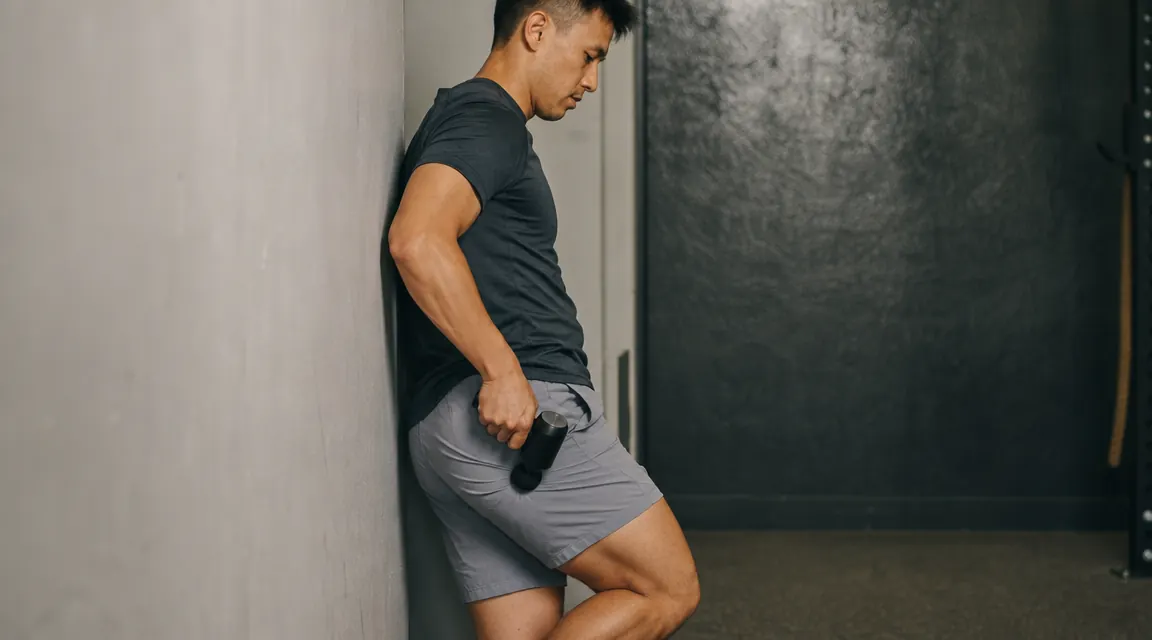
For the 170-lb runner I lent the gun to, stall force was never an issue. Running through calves, shin muscles, quads, and upper traps at 35 lbs of stall force is entirely sufficient for tissue that is lean and responsive. For the 215-lb strength athlete, it was a problem within the first session. He pressed the gun into his gluteus maximus with the force he would normally apply to get a meaningful stimulus, and the motor stalled. He tried bracing the gun against a wall and leaning into it with his body weight, and that workaround is usable, but it is not the experience of a tool that was designed for his use case. He stopped using it after a week and told me the Q2 Mini was 'clearly not for people like me.' He was right, and BOB AND BRAD would probably agree: this product is positioned for portability and general use, not for deep-tissue work on high-mass posterior-chain athletes.
35 lbs of stall force is plenty for calves, upper traps, lats, and most of the lower leg. It is not enough to do meaningful work on a dense glute without a wall-brace workaround. If you train your posterior chain seriously, that matters.
The honest way to frame it: if you are under 185 lbs and your recovery priorities are calves, hamstrings, lats, and neck tension, stall force will never be a limiting factor. If your primary pain point is post-squat glute tightness and you are carrying significant muscle mass, the Q2 Mini is not your tool. Check the BOB AND BRAD Q2 Mini vs Theragun Relief comparison to see how the stall force difference plays out between two guns at different price points in the same mini category.
The Travel Case: Better Than Expected, With One Real Flaw
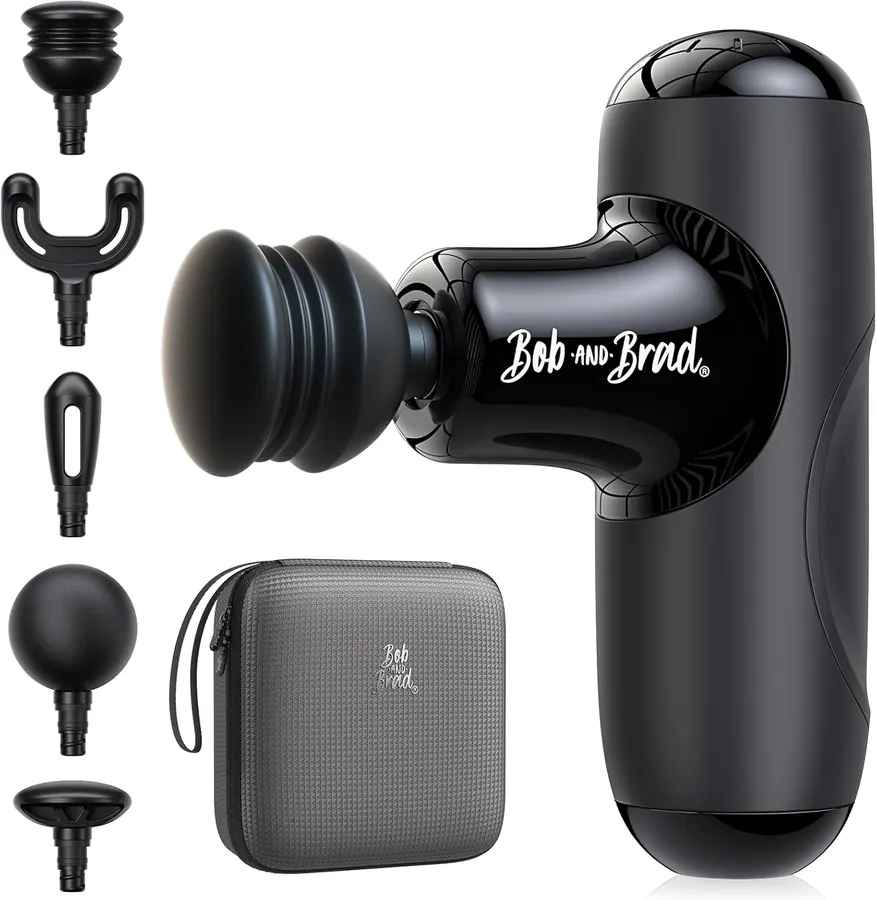
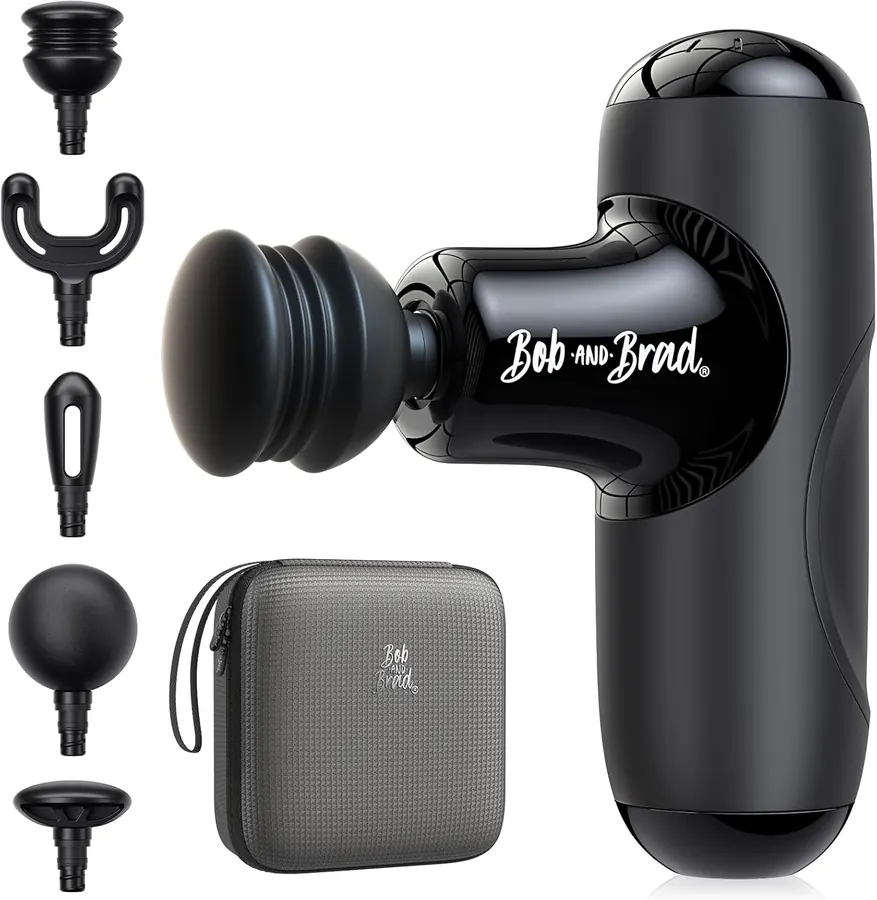
The Q2 Mini ships with a zippered travel case that holds the gun, all four attachments, and a charging cable. For a product in this price range, the case is genuinely above average. The foam cutouts hold each attachment securely, the zipper feels durable, and the case fits into a gym bag without taking up a meaningful footprint. Most guns at this price point ship in a plastic clamshell that you throw away after day two because it takes up too much space. The soft case here is a real packaging upgrade.
The flaw: the case has no designated spot for the USB-C cable unless you specifically tuck it into the side pocket, which is small. I watched both athletes who tested this gun within the first two weeks lose the charging cable in their bag because it was not secured inside the case. If you lose the USB-C cable, you can replace it with any standard cable since the Q2 Mini uses a universal port, which is the correct design choice. But the case could do a better job of integrating the cable storage. After a month of daily use, most people end up leaving the cable on a nightstand and not in the case at all, which means the 'everything organized in one place' pitch degrades over time.
Amplitude and Noise: What the Marketing Copy Downplays
Amplitude is the depth of each percussion stroke, measured in millimeters. On a full-size gun, amplitude is typically 12-16 mm. On the Q2 Mini, amplitude is approximately 10 mm. That 2-6 mm difference sounds small, but it correlates directly with how deep the percussive stimulus penetrates into the tissue. On a large, superficial muscle like the upper traps or the belly of the quadriceps, 10 mm is effective. On a deeper muscle group or on tissue with significant overlying bulk, the shallower amplitude means you are working the superficial layers more than the deep ones. That is fine for most people doing general recovery work. It is a limitation worth knowing if you are hoping to use this gun the way a sports medicine clinic uses a full-size percussion tool.
On noise, the Q2 Mini performs well. BOB AND BRAD rates it at 40-50 dB depending on speed and load, and that matches real-world use closely. At speed 2 with moderate pressure, it is quieter than a ceiling fan at low setting. At speed 3 under hard load on dense tissue, it rises to something closer to a laptop cooling fan under heavy CPU use. It is not the whisper-quiet experience some reviews describe, but it is genuinely quiet enough for hotel rooms, apartment living, and late-night recovery sessions after the household is asleep. Noise is not a legitimate objection to this gun.
Build Quality Over Time: What Holds and What Loosens
The attachment connection point on the Q2 Mini is a friction-fit magnetic collar, which is the right design for a device that gets used daily. Magnetically secured attachments do not require alignment pegs or threading, and they seat firmly enough that the head does not wobble during use. After extended regular use, one pattern in the low-star reviews is worth noting: the magnetic collar on some units develops slight play after aggressive daily use over several months. This is not universal, and BOB AND BRAD has a customer service reputation that is better than average in this product category, but if you are passing the gun between multiple people in a household and the attachment is being swapped frequently, check the collar periodically.
The rubberized grip texture on the handle holds up well. I have not seen any reports of the grip peeling or deteriorating even with regular sweat exposure during use. The power button and speed selector are tactile and require firm deliberate presses, which means you do not accidentally change speed mid-use, but also means it requires intention to operate with gloves on or wet hands. The on/off behavior is slightly unintuitive at first: hold for two seconds to power on, tap to cycle speeds, hold for two seconds to power off. If you power it on and immediately start cycling speed, you can accidentally hit the max speed setting before you intended to. Takes about two sessions to internalize the sequence.
What I Liked
- USB-C charging via any standard cable, no proprietary cord to lose
- Soft travel case with individual foam slots for each attachment is above average for the price range
- 40-50 dB noise level is genuinely quiet enough for apartment and hotel use at any speed
- Magnetic attachment collar seats firmly without wobble during use
- Compact enough to fit in a gym bag side pocket without reorganizing anything
- Customer service reputation is responsive for a product in this category
Where It Falls Short
- Battery life at speed 3 under hard load is closer to 2-2.5 hours, not the headline 3-4 hours
- 35 lb stall force limits effectiveness on dense glute and posterior-chain tissue for larger athletes
- 10 mm amplitude is shallower than full-size guns, reducing depth of stimulus on thick muscle groups
- Cable has no dedicated secure storage inside the travel case and tends to migrate into the bag
- No force-feedback or pressure indicator, so new users cannot tell if they are applying effective pressure or just spinning the attachment against the skin
Does the 4.7-Star Rating Hold Up Under Scrutiny?
Yes, with a qualifier. The Q2 Mini earns its high rating from the population it was designed for: people who want a portable, daily-carry percussion massager for general post-workout recovery and travel. Within that population, it is a well-executed product. The battery is adequate for most use patterns, the noise floor is genuinely low, the attachments cover the most common applications, and the price sits in a range where the value-to-performance ratio is honest rather than aspirational.
Where the rating becomes misleading is when a buyer with a different use case sees 4.7 stars and assumes those stars translate to their specific need. A 220-lb powerlifter doing heavy Romanian deadlifts four times a week and hoping to use a massage gun for serious post-workout glute work is not the same buyer as a 145-lb runner managing calf tension. The Q2 Mini earns 4.7 stars from the second person and probably earns 3 stars from the first, but the first person is less likely to know they were the wrong buyer until after the purchase. That is the honest gap this review is trying to fill. For a direct comparison that quantifies exactly where the Q2 Mini wins and where a dedicated alternative makes more sense, see the BOB AND BRAD Q2 Mini long-term use review which tracks actual performance metrics across an extended training block.
Who This Is For
The Q2 Mini is built for athletes and active adults who train 3-5 days a week at moderate-to-high volume and want a percussive recovery tool that actually lives in their gym bag instead of sitting on a shelf at home. It is ideal for runners managing lower-leg and calf tightness, lifters under 190 lbs working on upper-back, neck, and quad tension, and anyone who travels frequently and wants recovery continuity across time zones and hotel rooms. If you are new to percussion massage and want to find out whether it actually helps your recovery pattern before spending $200-plus on a full-size device, the Q2 Mini is the honest entry point.
Who Should Skip It
Skip the Q2 Mini if your primary recovery need is deep tissue work on the glutes, paraspinals, or any large, dense muscle group where you need to apply significant pressure to get a stimulus. If you are a larger athlete, a powerlifter, or someone whose training consistently leaves the posterior chain as the dominant soreness site, the stall force limitation will make this gun feel inadequate within the first week. Also skip it if you are hoping the compact format means the performance is simply scaled down proportionally from a full-size gun. The performance gaps at the extreme ends of pressure and amplitude are real, not just a matter of size. Spend the difference and buy a full-size gun with a higher stall force rating. You will not regret the extra weight in your bag.
The right tool for the right athlete is the only review question that matters.
If the Q2 Mini fits your training profile, the 15,000 reviews are not wrong about what it does well. Check the current price on Amazon, read the sizing section one more time, and make the call with your actual use case in mind rather than the marketing headline.
Amazon Check Today's Price on Amazon →