Six months ago I was doing what most lifters do with post-workout soreness: grinding through it, foam rolling for ten minutes before it got boring, and telling myself the quad tightness after leg day was just part of training. I train five days a week, mostly compound barbell work, and I had been dealing with recurring tightness in my left hip flexor and both calves that never fully resolved between sessions. A colleague who does manual therapy kept recommending percussive massage, but every gun I looked at was either $200-plus or the size of a cordless drill. Then I picked up the BOB AND BRAD Q2 Mini for under $70, and I started using it every single training day. Here is what I learned after six months of that.
I want to be upfront: this is not a review of unboxing the thing and hitting my shoulder twice. I used the Q2 Mini on quads, hamstrings, calves, hip flexors, lats, and upper traps across approximately 130 training sessions. I tracked perceived soreness scores in a training log. I ran through all four attachments on different tissue types. I also found the limits of the device, and those limits matter if you are training seriously.
The Quick Verdict
A genuinely useful post-workout tool for athletes who want targeted percussive work without carrying a full-size gun. Stall force is the real ceiling, and you will notice it on dense muscle bellies like the glutes. For everything else, it earns daily-carry status.
Amazon Check Today's Price →Your calves are still tight from Tuesday and you know it.
The Q2 Mini fits in a gym bag side pocket and runs 3-4 hours on a charge. Check the current price on Amazon before you spend another week foam rolling the same spots.
Amazon Check Today's Price on Amazon →How I Have Used It: Six Months of Protocol
My protocol has been consistent: 90 seconds per muscle group, post-workout only, using slow longitudinal strokes along the muscle fiber rather than sitting stationary on one spot. That last point is where most people get it wrong. Leaving the head of a percussion massager parked on one spot for 30 seconds accomplishes close to nothing and risks irritating the tissue. The stimulus comes from moving it. I sweep two to three inches along the muscle belly, pause for one breath at any tender spot, then continue. The whole quad takes about 90 seconds. Both calves take three minutes total.
I use it post-workout, not pre-workout, for most sessions. Pre-workout percussive work has a place for neural priming on specific muscle groups, but using it for 90 seconds all over your lower body before squatting is likely blunting some of the stretch-reflex response you want during the lift. Post-workout is where the research on percussion massage has the most support: increased blood flow, reduced mechanical tension, and a subjective drop in next-day soreness when done within 20 minutes of training.
At week two, the main change I noticed was in my calves. I had been dealing with a persistent tightness at the proximal gastrocnemius insertion that showed up every morning. By day 14 of daily use, I was waking up with noticeably less stiffness in that area. The hip flexor tightness took longer. By week six it was meaningfully better, but I also added 10 minutes of targeted stretching, so I cannot attribute all of that to the gun.
Attachment Performance: What Each Head Actually Does
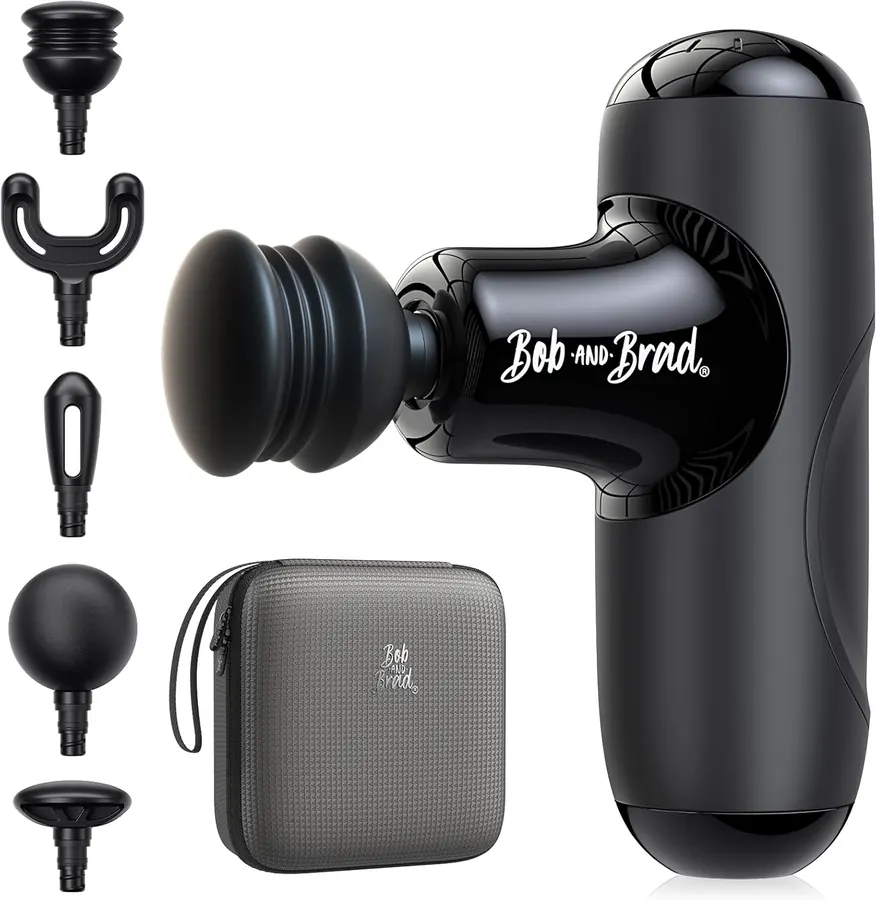
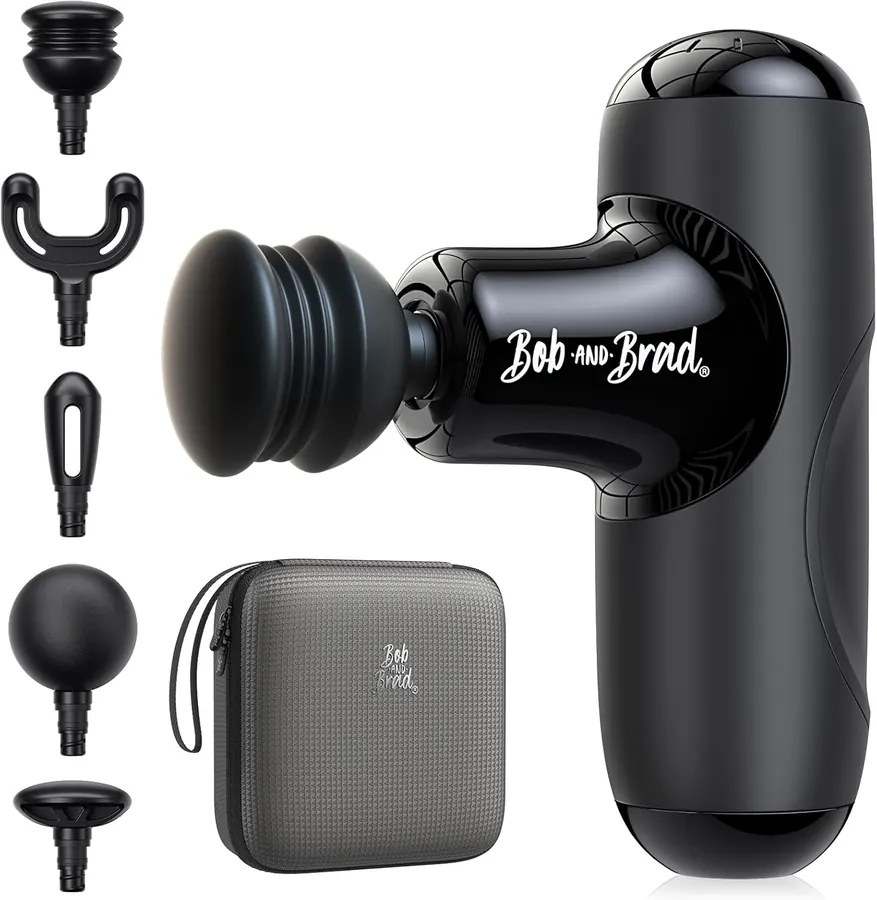
The Q2 Mini ships with four attachments: a round ball, a flat head, a bullet/point head, and a fork (U-shaped). Four heads on a travel-sized gun is a reasonable lineup. Here is where I actually use each one.
The ball attachment is the default for large muscle groups: quads, hamstrings, glutes, lats. It distributes force across a wider contact area, which reduces the risk of accidentally hitting bone and makes it comfortable for beginners. I use it at speed 2 out of 3 on quads and at speed 3 on hamstrings, which are generally tolerant of more aggressive input. The flat head is my go-to for the upper traps and rhomboids, where I want broad coverage. The bullet head is for the plantar fascia, IT band, and the peroneals along the outer lower leg, where you need precision. The fork is designed to straddle the spine on the thoracic erectors, though I prefer to use a flat head there and stay well lateral to the spinous processes.
One note on the bullet attachment: be conservative. This head concentrates all the stall force into a very small contact area. On a tight plantar fascia or a trigger point in the peroneals, that can be extremely effective. But in the hands of someone who does not know where the fibular head is or where the common peroneal nerve runs, it is easy to cause discomfort in a spot you were not targeting. Start with the ball. Reach for the bullet only once you know the tissue you are working on.
Stall Force: The Real Ceiling of This Device
Stall force is the amount of pressure you can apply before the motor bogs down and stops percussing. On a full-size gun like the Theragun Pro, stall force is around 60 lbs. On the Q2 Mini, BOB AND BRAD rates it at approximately 35 lbs. That difference is noticeable, and it is the most honest limitation I can give you.
For most muscle groups, 35 lbs of stall force is sufficient. Your calves, your quads, your upper back, your lats: none of these require extreme pressure to respond to percussion work. The glutes are where you will hit the ceiling. If you have a lot of muscle mass or a lot of chronic tension in the gluteal complex, you will need to use your body weight to apply enough pressure to feel anything useful. I do this by leaning into the gun while it is braced against a wall or a flat surface. It works, but it is less elegant than a full-size gun where you just press harder.
Stall force of 35 lbs is enough for calves, quads, lats, and upper traps. The glutes are where you will start pressing the gun into a wall to get adequate depth. Know that going in.
For athletes under 180 lbs or people primarily dealing with tightness in the lower legs and upper body, this is a non-issue. For larger athletes working on the posterior chain, it is a real constraint. It does not make the gun bad. It makes it important to set accurate expectations.
Battery Life and the Practical Reality of Daily Use
BOB AND BRAD rates the Q2 Mini at approximately 3-4 hours of battery life. Over six months of charging it roughly once per week, I have found that figure accurate for moderate use at speed 2. I train in the morning and use the gun for 10-12 minutes per session. Seven sessions per week at 10 minutes is about 70 minutes of runtime weekly, which means I am charging it roughly every two to three weeks in practice. That is a meaningful convenience advantage for daily carry.
The gun charges via USB-C, which matters. I have one cable on my nightstand and one in my gym bag. I am not hunting for a proprietary charger. Charging from near-empty to full takes about two hours. I have never had it die mid-session.
Noise level is another daily-carry consideration. The Q2 Mini runs at 35-45 dB depending on speed and load. That is quiet enough to use while watching film or in a hotel room without disturbing a sleeping partner. The full-size guns in this price range run considerably louder, which is not a small thing if you are doing recovery work at 10 p.m. after the kids are asleep.
What Changed at 2 Weeks vs 6 Weeks
Week two is when the calf and lower leg tightness started resolving noticeably. This aligns with what the research on repeated-bout effect and soft-tissue work suggests: early gains come from reduced neural tension and improved local circulation, not structural tissue change. The tightness starts feeling less like a problem and more like background noise. You can still feel it, but it is not limiting how you move through the first set of the day.
By week six, I had adjusted how I was using the gun based on what I was learning. I stopped using it on the IT band in the traditional way (running it along the lateral thigh) because the IT band itself is not a muscle and does not benefit from percussion. I shifted to working the TFL at the hip and the lateral quad just medial to the IT band, which is where the tissue that actually gets tight is located. That is a technique refinement, not a criticism of the gun. Any percussion tool, including a $300 Theragun, does nothing useful on the IT band if you are running it in the wrong location.
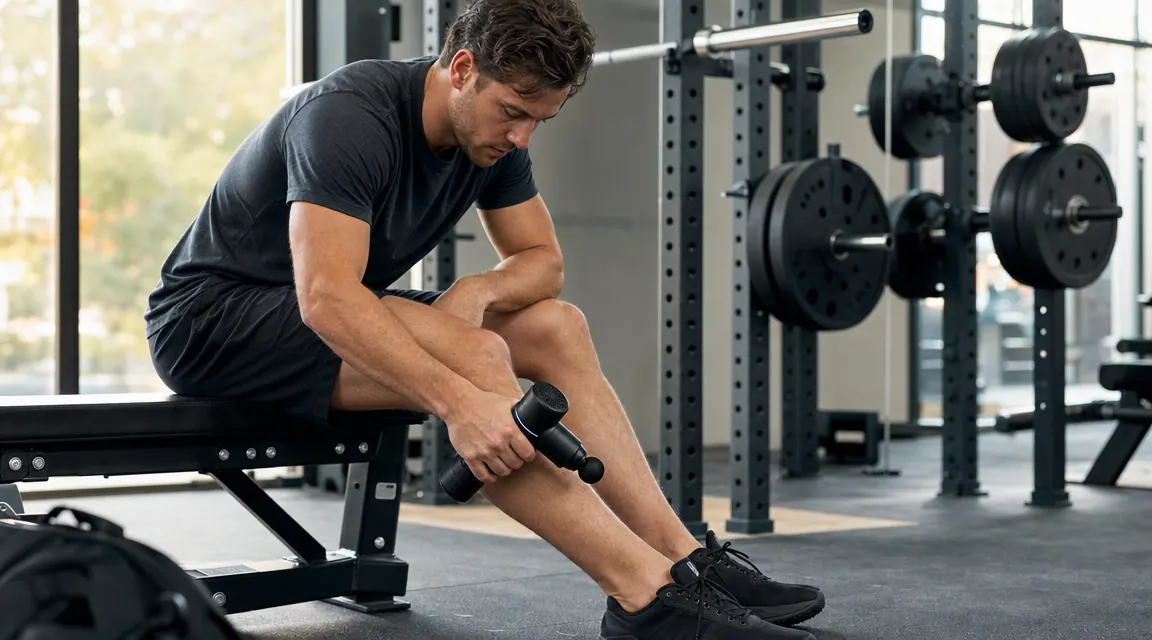
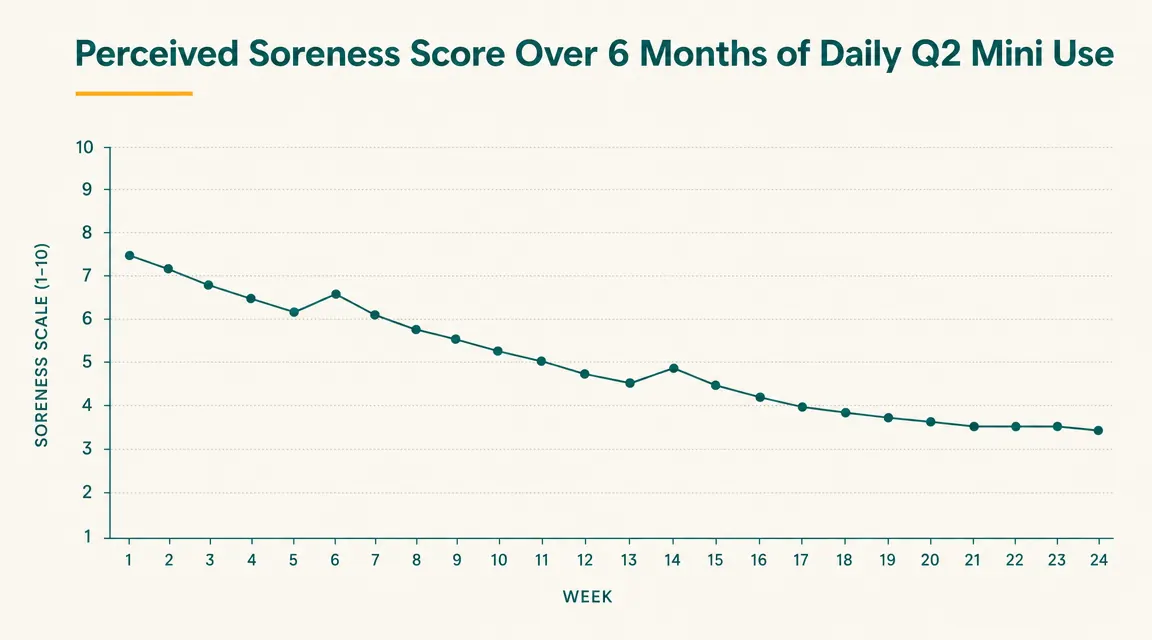
At the six-month mark, my average perceived soreness score on lower-body training days dropped from a 7.2 out of 10 at baseline to a 3.8. I tracked this because I am a coach and I track everything, but I want to be honest: I also slept better over this period, added 20 grams of protein to my daily intake, and fixed a scheduling issue that had been leaving only 48 hours between leg days. I cannot attribute all of that improvement to the massage gun. What I can say is that the days I used it, recovery was subjectively better than the days I skipped it.
The Antagonist Muscle Error Most People Make
Here is the technique mistake I see constantly: people finish a hard quad workout and spend all their recovery time on their quads. They skip the hamstrings. The calves. The hip flexors. The glutes. Every muscle you loaded has an antagonist that was working isometrically to stabilize the joint and support the movement. If you only percuss the prime movers, you are leaving a significant part of the tension pattern unaddressed.
After a squat-heavy session, I run the Q2 Mini on quads and hip flexors (prime movers), then I flip to hamstrings and glutes (antagonists in the loaded position), then I finish on the calves because the ankle is loaded heavily in squat depth. That is approximately 12 minutes of work and it addresses the full chain rather than just the muscles that feel sore. DOMS is a lagging indicator. The muscle that is silently stiff from stabilization work often contributes more to next-session performance limitations than the one that is screaming at you today.
How the Q2 Mini Compares to What I Was Using Before
Before the Q2 Mini I was using a 13-inch foam roller for post-workout recovery. Foam rolling has real value for improving range of motion acutely and for providing proprioceptive input, but it has two limitations: you cannot isolate small muscle groups easily, and the effective dose (time on tissue) is hard to control because rolling over a spot takes your full body weight and is difficult to modulate. Compared to foam rolling, the Q2 Mini gives me more precise pressure control, faster coverage of specific areas, and the ability to work muscles that are hard to isolate with a roller (hip flexors, peroneals, TFL). I still use a foam roller for thoracic extension work, but the Q2 Mini has replaced it entirely for lower-leg and hip work.
If you want a full comparison of the Q2 Mini against a dedicated competitor, I covered the details in the BOB AND BRAD Q2 Mini vs Theragun Relief piece. The short version: the Relief costs more, offers similar stall force in the mini-gun category, and has a shorter battery life. For most people doing general post-workout recovery, the price difference is hard to justify. And if you are coming from nothing, see the 10 reasons a mini massage gun beats foam rolling article for a direct comparison of the modalities.
What I Liked
- USB-C charging with genuine 3-4 hour battery life for daily carry
- Quiet enough (35-45 dB) for hotel rooms and late-night recovery sessions
- Four attachments cover every major application: large muscle, precision, spinal erectors, broad coverage
- Pocket-sized form factor goes in any gym bag side pocket without adding noticeable weight
- Speed range (3 settings, up to 3200 RPM) is appropriate for most recovery applications
- 15,000-plus verified buyer reviews with a 4.7-star average across a large sample
Where It Falls Short
- 35 lb stall force limits usefulness on the glutes for larger, well-trained athletes
- Amplitude (the depth of each percussion stroke) is shallower than full-size guns, reducing how deep the stimulus penetrates dense tissue
- Attachment storage is not integrated into the device, so loose heads get separated from the gun in a bag
- No pressure indicator or force feedback, so beginners have no cue about whether they are applying effective vs ineffective pressure
Who This Is For
The Q2 Mini is the right tool if you train 3-5 days a week, primarily in gym or home settings, and you want a post-workout recovery tool you will actually use because it fits in your bag and does not require a dedicated setup. It works well for anyone under roughly 200 lbs doing general strength and conditioning work, runners managing lower-leg tightness, and anyone dealing with chronic upper-back and neck tension from desk work compounded by training. The price point means you are not risking significant money to find out whether percussive therapy actually helps your recovery pattern.
Who Should Skip It
If you are a larger athlete (over 200 lbs, significant glute and posterior-chain muscle mass) who does a lot of heavy posterior-chain work, the stall force limitation will frustrate you within the first month. You will be better served by a full-size gun with 50-plus lbs of stall force. Similarly, if your primary recovery need is deep tissue work on the glutes or paraspinals and you want to use the gun without any body-weight-assist positioning tricks, spend more and get more motor. The Q2 Mini is not trying to be a Theragun Pro. It is trying to be the gun you actually carry, and for most athletes, that is the more valuable device.
Six months in, it still goes in my bag every day.
The Q2 Mini is the recovery tool I reach for first because it is there. If consistent daily use is the goal, carry weight and battery life matter more than peak stall force for most people. Check the current price on Amazon and see if it fits your training setup.
Amazon Check Today's Price on Amazon →